StreamZero: The Autonomy Platform
Build & govern complex enterprise systems faster than ever before. A governed runtime platform and development framework for building complex enterprise systems across microservices, workflows, events, and intelligent agents.
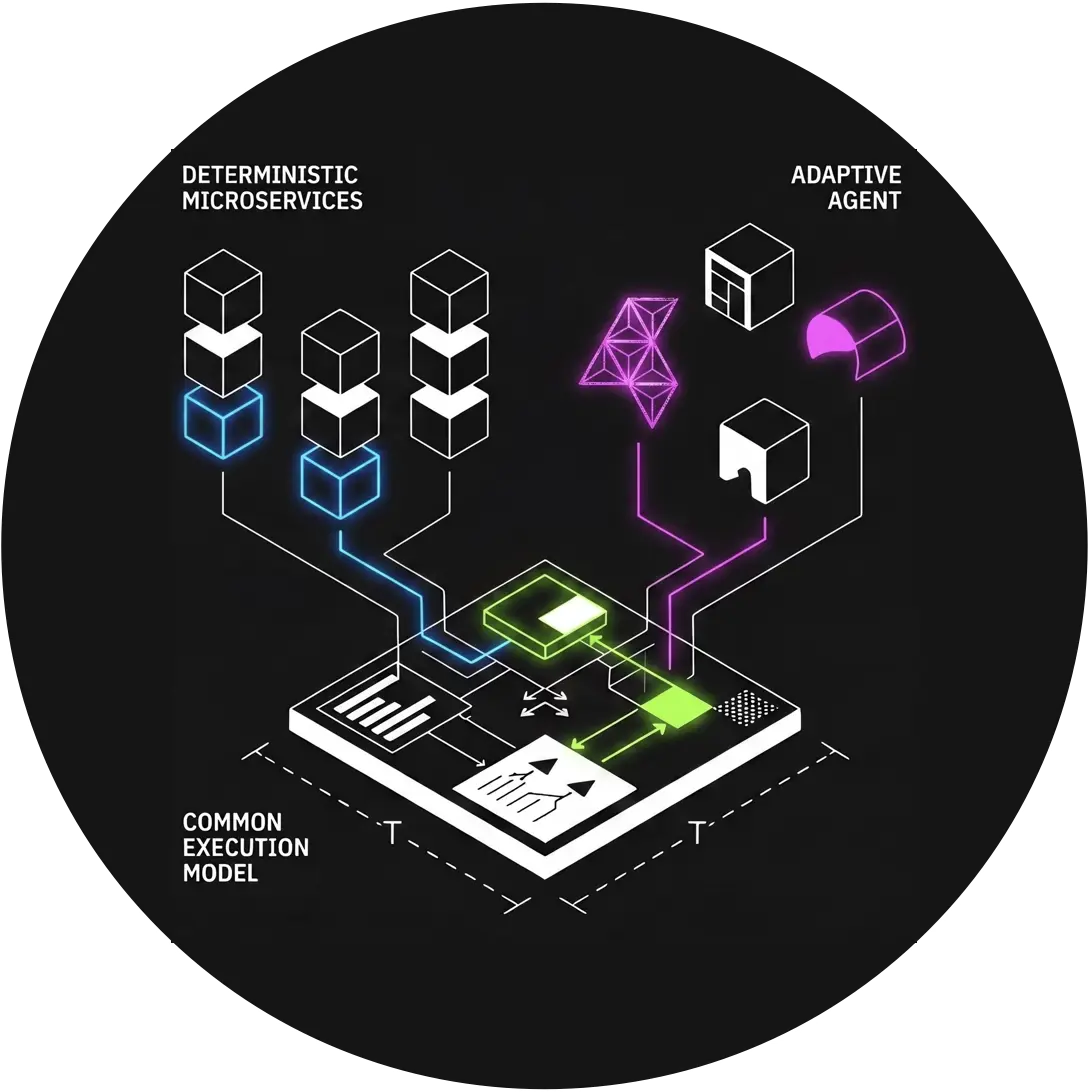
One framework across services, workflows, and agents
Govern adaptive execution with deterministic control
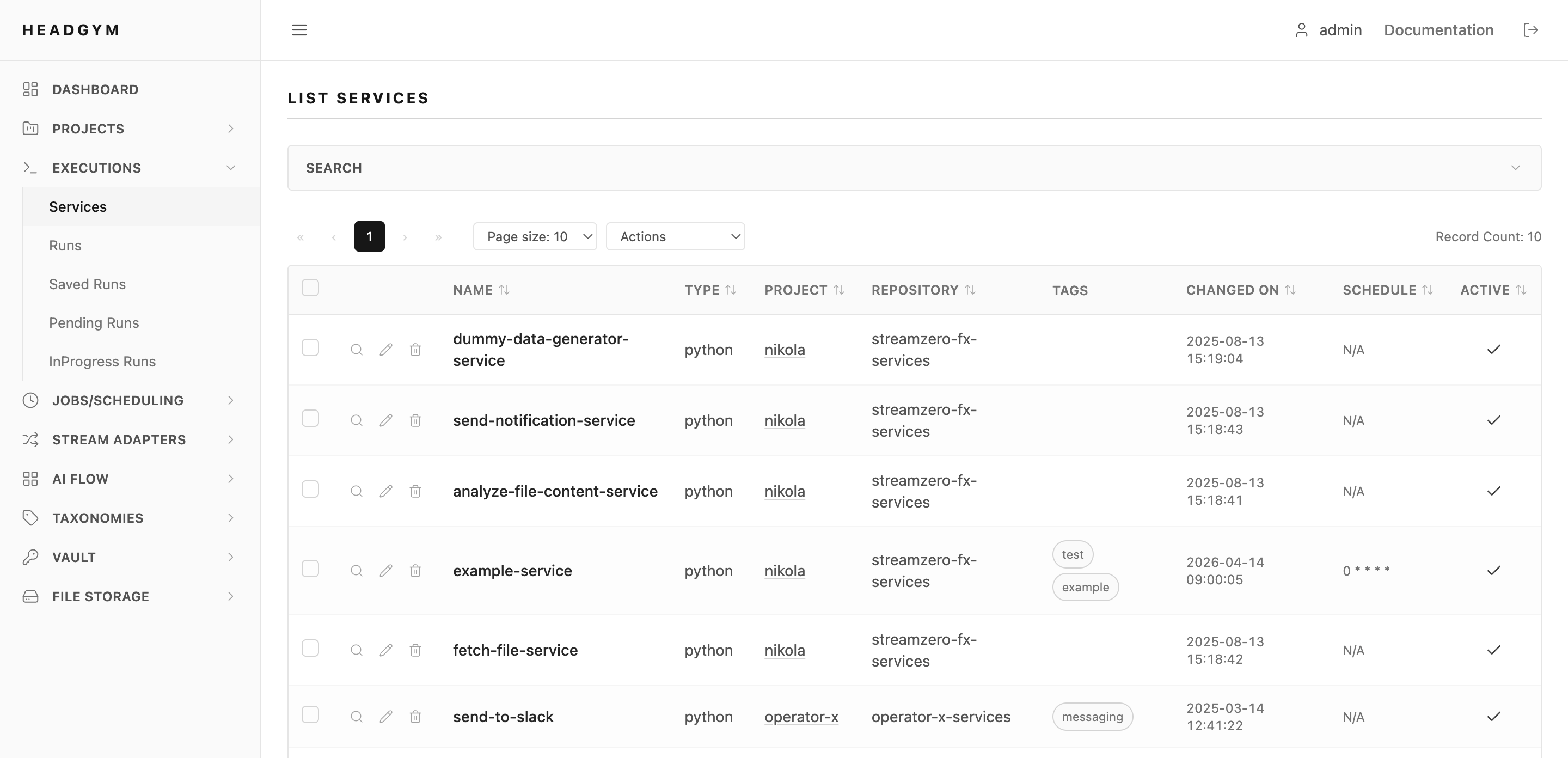
Enterprises need more than AI features.
AI is moving into production operations, but the larger problem is architectural. Most enterprise software delivery still depends on fragmented coordination across APIs, microservices, workflow tools, event brokers, custom glue code, and now agent frameworks.
More moving parts per enterprise workflow vs. five years ago
Of AI projects stall at integration and governance, not capability
Of delivery time spent on custom glue and coordination logic
Higher recovery cost when observability is absent at business layer
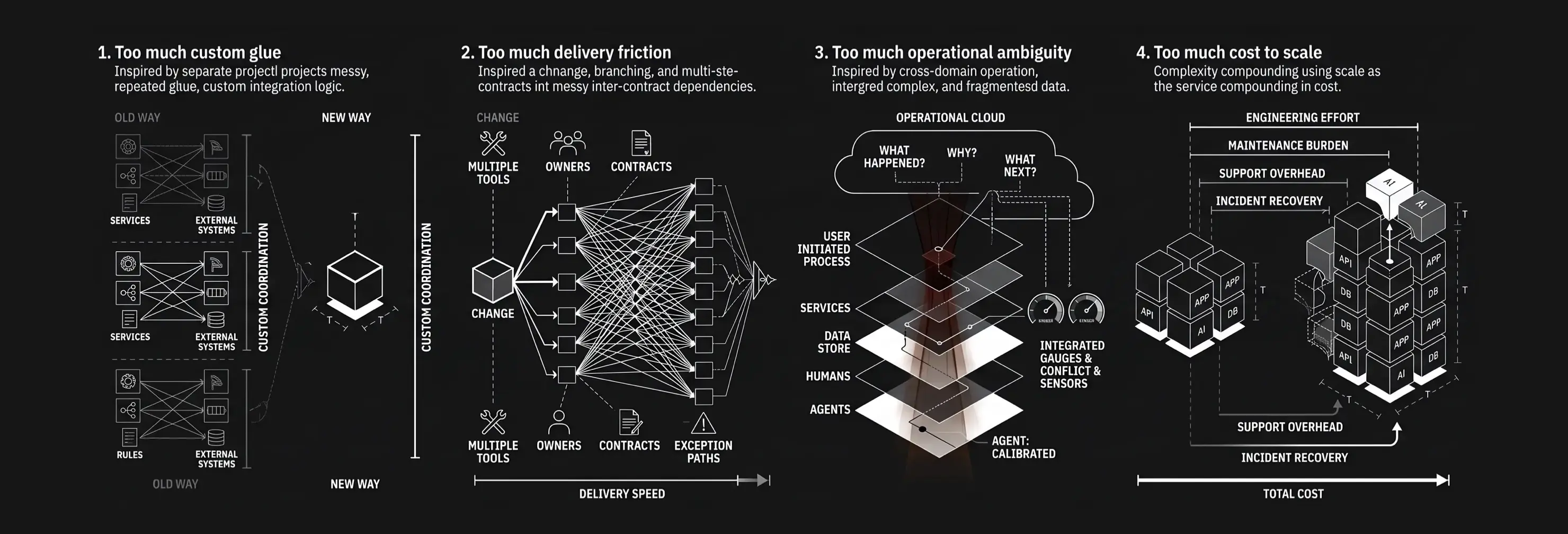
Today's enterprise stack makes complex delivery slower.
Traditional architecture handles deterministic processes reasonably well. Modern AI tooling introduces flexibility. But most organizations are forced to stitch these worlds together manually.
Too much custom glue
Teams repeatedly recreate coordination logic between services, workflows, queues, rules, and external systems.
Too much delivery friction
Every change touches multiple tools, owners, contracts, and exception paths, slowing down delivery.
Too much operational ambiguity
When work crosses services, humans, and agents, it becomes hard to see what happened, why, and what should happen next.
Too much cost to scale
Complexity compounds across engineering effort, maintenance burden, support overhead, and incident recovery.
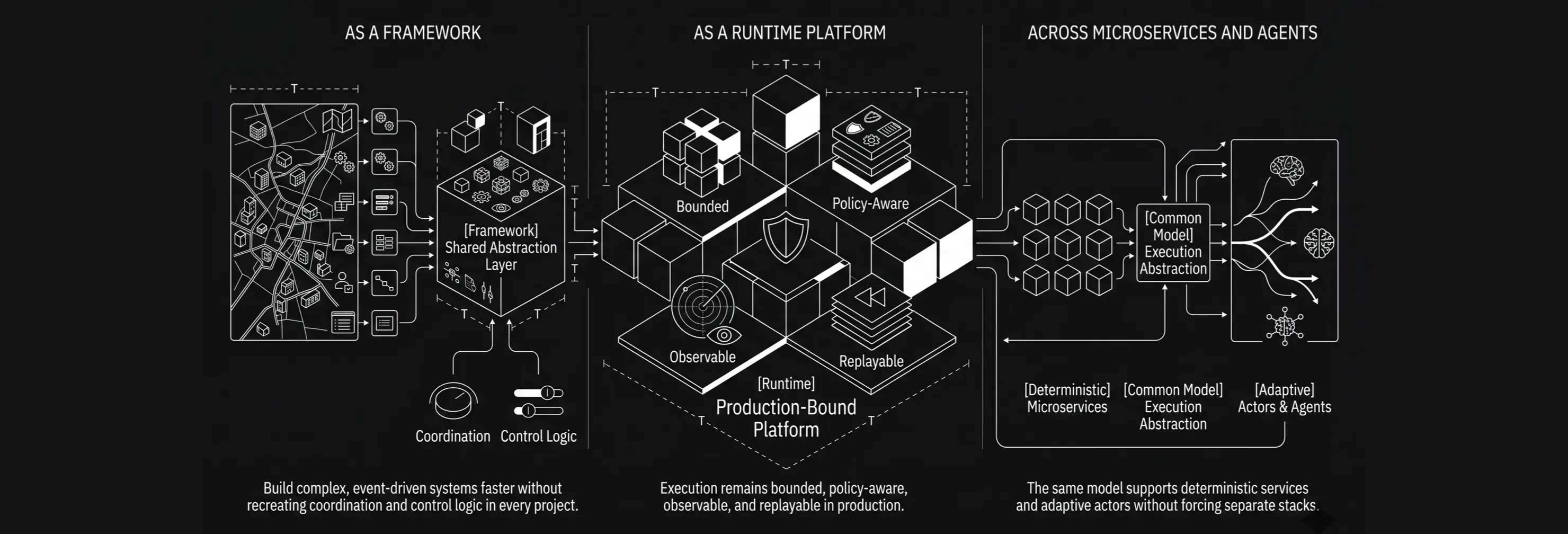
A framework & runtime for governed enterprise execution
StreamZero gives enterprises a shared way to build and run complex systems — a common execution model across events, services, workflows, processors, and agents.
Build complex, event-driven systems faster without recreating coordination and control logic in every project.
Execution remains bounded, policy-aware, observable, and replayable in production.
The same model supports deterministic services and adaptive actors without forcing separate stacks.
One execution model for complex, adaptive systems
Represent business activity as events
Requests, approvals, triggers, exceptions, external signals, and system outputs are captured as structured events.
Creates shared context across teams instead of siloed tool state.
Route work to the right participant
Events are matched to services, workflows, processors, humans, or agents using contracts, metadata, and policy.
Keeps coordination flexible while remaining intentional.
Let each execution unit do what it does best
Microservices handle deterministic work. Workflows manage process structure. Agents interpret context where reasoning helps.
Unifies multiple system styles instead of forcing separate architectures.
Apply deterministic boundaries before critical actions
Where certainty matters, adaptive outputs are converted into structured, validated, governed actions.
This is how enterprises get value from agents without uncontrolled behavior.
Observe and replay the full flow
Teams can trace, inspect, diagnose, replay, and recover business execution across distributed systems.
Makes operations explainable, auditable, and resilient.
Practical gains in delivery, operations, and governance
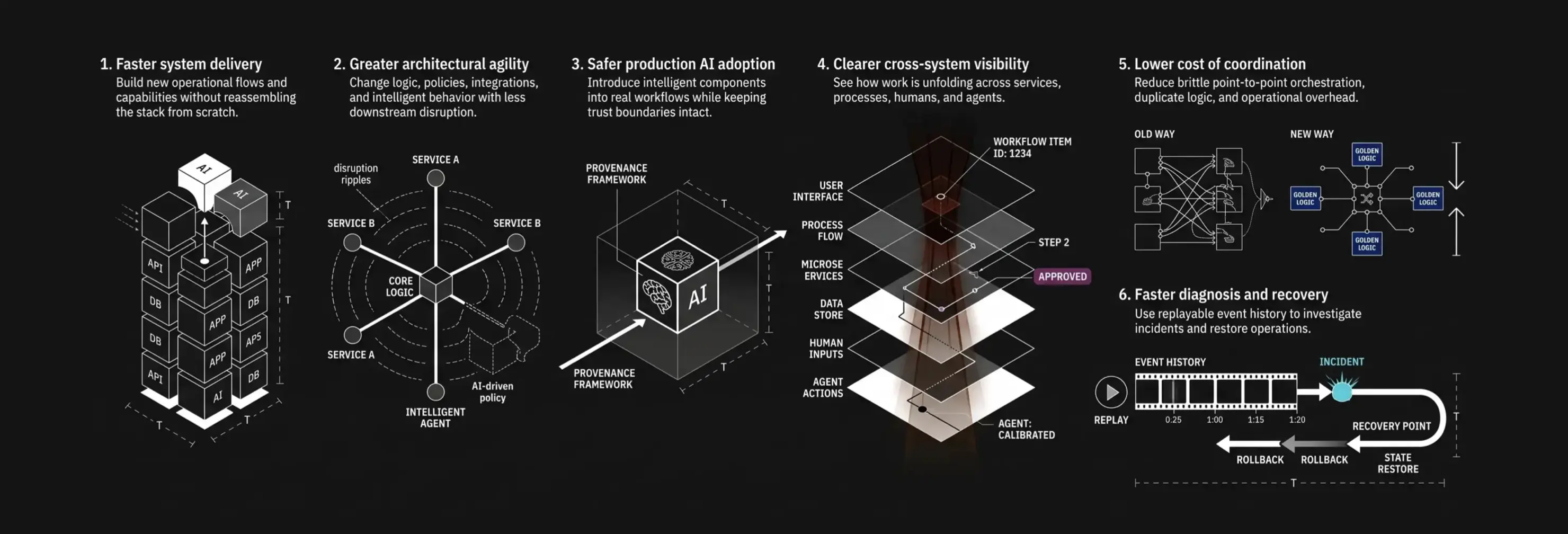
Faster system delivery
Build new operational flows and capabilities without reassembling the stack from scratch.
Greater architectural agility
Change logic, policies, integrations, and intelligent behavior with less downstream disruption.
Safer production AI adoption
Introduce intelligent components into real workflows while keeping trust boundaries intact.
Clearer cross-system visibility
See how work is unfolding across services, processes, humans, and agents.
Lower cost of coordination
Reduce brittle point-to-point orchestration, duplicate logic, and operational overhead.
Faster diagnosis and recovery
Use replayable event history to investigate incidents and restore operations.
Where StreamZero creates the most leverage
Fraud operations
An event triggers investigation. Services gather signals, rules score risk, an agent summarizes context, and a governed decision point controls the next action.
Faster triage, bounded decision-making, lower operational friction.
Claims coordination
Claims execution spans document handling, policy checks, service coordination, exceptions, human approvals, and agent-assisted interpretation in one shared model.
Less fragmentation, better visibility, and lower cost to change the process.
Platform modernization
Replace brittle custom glue between services, workflows, queues, and rule-heavy systems with a reusable execution framework that supports future agent adoption.
Faster delivery now and a better path to adaptive systems later.
AI operationalization
Move from isolated copilots to governed, production-grade intelligent participation inside real operational systems.
AI becomes part of enterprise execution, not a disconnected side feature.
Not another workflow tool. Not another agent framework.
Beyond workflow engines
Workflow tools are useful for predefined paths. StreamZero helps when business execution spans changing events, modular services, humans, and bounded intelligent actors.
Beyond agent frameworks
Agent frameworks provide flexibility, but often without the control model enterprises need to build trust at scale in production.
Beyond event brokers
Brokers move messages. StreamZero governs how distributed work is designed, coordinated, and operated across the full lifecycle.
Beyond platform sprawl
Instead of adding another disconnected layer, StreamZero gives teams one shared framework across build-time and runtime concerns.
Why it matters
A cleaner path from idea to operated system
StreamZero helps developers move faster, platform teams enforce consistency, and technology leaders reduce the cost of architectural sprawl.
For developers
Less setup. Clearer patterns. More time on product logic.
For platform teams
More consistency, more governance, fewer custom paths.
For leaders
Better scalability of delivery without multiplying operational complexity.
Build complex adaptive systems without paying the usual complexity tax
If your team is trying to modernize enterprise workflows, operationalize AI, or reduce the drag of coordinating microservices, events, and decision logic, StreamZero offers a more unified path.
Ready to see how StreamZero fits into your enterprise stack? Book a working session with our team.